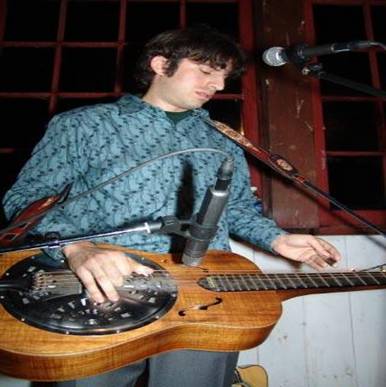
David Hamburger

Originally published at http://www.robanderlik.com in 2008

dh with Cindy Cashdollar

SJ: Tell us about your musical chronology: where did you grow up, how did you get started playing music and when did you start playing resonator guitar?

DH: I grew up in Lexington, Massachusetts, which is a suburb a little Northwest of Boston. My father plays piano, and so did my grandfather, so I grew up hearing lots of standards and older pop songs as well as the Bach inventions and Chopin and Beethoven pieces my dad liked to play. My first instrument was the violin, because you could start on a stringed instrument a year earlier than the brass and woodwinds and I was just dying to start playing something; I played violin all the way through high school, but as soon as I got a guitar, it was really all over for the violin. I went to a summer camp in New Hampshire for a couple of years in junior high where there was a lot of old-timey and folk music and I learned a little clawhammer banjo; when I got back from camp and wanted to continue with it, my parents borrowed a guitar from the neighbors instead and signed me up for group lessons with a local teacher who turned out to be Lucille Magliozzi, the sister of the Car Talk guys. So that was my introduction to bluegrass – she taught us flatpicking and fingerpicking, and showed us a few fiddle tunes as well, which was very weird considering that everyone around me was into Kiss and Peter Frampton that year. At exactly the same time, my sister got all these Beatles records for her birthday, and sat me down to check them out, so that was my world: George Harrison and “The Girl I Left Behind Me.” In high school, I found out about B.B. King and John Renbourn, and also, I suppose, Preston Reed and the Allman Brothers, so I was into both fingerstyle guitar and anything having to do with the blues by the time I got to college.


My freshman year at Wesleyan University, I was studying harmony and counterpoint and pretending to understand Thucydides when I met Steadman Hinckley, who was a senior, a Russian major, and the rehearsal hall monitor on the same night I had my classical guitar lessons. He played slide guitar, and used to hang out and practise on an old Guild dreadnaught in between signing people in and out of the building. So he showed me open D tuning and how to play Duane Allman licks over a steady thumb bass, and we would go into the stairwell of this three-story cinderblock building and hammer away at a blues in D for forty-five minutes at a time with all this fabulous natural reverb bouncing off the walls and the ceiling.

When I got out school I moved to New York, and I thought that I wanted to be a jazz guitarist, which is what I’d ended up studying in school, and I had a half a dozen lessons with Emily Remler, who was obsessed with Wes Montgomery but also made some lovely records of her own (Transitions is the one to get, for my money). Slide guitar was just this blowoff thing I did for fun, until a couple of friends took me to see Nancy Griffith at the Bottom Line; I was probably 23 or 24 and there was this guy in her band playing Dobro, pedal steel, fiddle and accordian. I thought, “I have to do that. And I have to do it now.” I went into Matt Umanov Guitars on Bleecker Street the next day and asked if they knew anybody who gave Dobro lessons; someone fished around in a drawer beneath the cash register and pulled out a business card. “Fats Kaplin does, give him a call.”

dh with Joan Baez

So I called the number they gave me and explained that I didn’t actually own a Dobro, but I wanted to learn to play; could I maybe come over for a lesson anyway and just play his and check it out? He said I could, so I went to this apartment building in the Village and went up to the eleventh floor; as I was coming down the hall the door opened and someone stuck their head out, and it was the guy, the same musician I’d seen with Nancy Griffith. I’d had no idea he lived in New York. He gave me about a two-hour lesson that day, showing me how to use the picks and the bar and how the high-G tuning worked. He told me to get some Flatt and Scruggs records with Josh Graves and played me a bunch of other things as well, and taught me his arrangement of “Grey Eagle.” He gave me a set of his fingerpicks, which were already bent into shape, and I went out and got a nut adapter for my acoustic guitar and a copy of Stacy Phillips’ The Dobro Book and started practising my slants and trying to figure out stuff off of records. I had a couple more lessons with Fats and when I’d been playing for a few months I went into the Music Emporium in Cambridge and found a 1930s Regal that had had the neck replaced by John Monteleone, and that was that. It had a really small body and a spruce top and sounded amazing; that was my main guitar for several years, and I still have it. I actually got to take some lessons with Stacy, too; I made him show me the basic Josh Graves open-position stuff and he really helped me understand how hammerons and pulloffs actually work.

SJ: How many instruments do you play? What do you consider to be your main instrument?

DH: I play acoustic and electric guitar, dobro and pedal steel, although I’ve hardly played steel at all since I left New York in 2000. I can also play just enough mandolin to squeak by in the studio, but that doesn’t count. I guess I consider myself a guitar player; I remember a Mike Auldridge interview in which they asked, “why do you keep calling them [meaning his Guersneys and Beards] guitars?” To which he replied, “Because it is a guitar, it’s a steel guitar.” and I suppose I think of it the same way – it’s a kind of guitar, so I’m basically a guitar player. But I do feel like I can express myself the most directly and emotionally when I’m playing some kind of slide instrument, whether it’s bottleneck guitar, lap-style resophonic guitar, pedal steel, or whatever.

SJ: Do you find one technique easier than the other? Do you have a preference for one vs. the other?

DH: I became a real snot about bottleneck guitar when I started playing lap-style: “Why would you even bother? You can’t slant, you can’t do hammerons and pulloffs, and you can’t get a clean sound,” blah, blah, blah. But you can hammeron and pulloff – just check out Ry Cooder – and all that scrape and clang is part of what makes bottleneck slide so excellent. I’ve come back around on slide guitar; I like being able to draw from both sides of the family. When I’m playing lap-style, I’ll steal anything that isn’t nailed down from the slide guitar guys I love – all those early Muddy Waters licks are just sitting there in open G tuning, since that’s what he was using then, and I still use everything I learned from Duane Allman about phrasing and right-hand technique in the closed position. And I’m sure I go for certain things now in open position on the guitar that are totally Dobroistic, if that’s a word.
 

OLYMPUS DIGITAL CAMERA

SJ: How long were you playing before you started playing in a band? Tell us about the bands you’ve played in. What kind of influence have other musicians that you have played with in bands had on own your own development as a musician?

DH: When I started playing the Dobro I was already playing guitar in Freedy Johnston’s band, so when I’d owned my Regal for about three months and been playing for six, we rehearsed some tunes for an acoustic set and played a gig somewhere in New York. I still remember looking down at my hands somewhere around the third tune and having this flash of, “whoa, what’s this all about?” Then everything went back to normal. I think I even used a crazy halfway-C6 tuning that I must have made up, to get a Western Swing sound on a song called “Truck Stop,” tuning down the top two strings to A and C. I also did my first sessions on Dobro with Freedy, playing on two songs on his first record, The Trouble Tree, in regular high-G tuning. I was probably about 25.

The whole time I was living in New York, I really wanted to play in a bluegrass band, sing harmony and play the Dobro, but it was hard to find a situation like that, so I played with singer-songwriters instead. I played on a lot of Fast Folk records, and toured with Jack Hardy, who’s been running a Monday night songwriter’s meeting on Houston Street in Manhattan since the late Cretaceous period. We went to Italy and I kept having to use my fifty words of Italian to explain about the Dopyera brothers in between large mouthfuls of gnocchi. I also worked with a songwriter named Jeff Tareila. Since it was just the two of us and he really loved the instrument, I got to take a zillion solos and play for as long as I wanted, especially if we wound up on some gig where we realized nobody was listening anyway. Playing with songwriters meant learning to negotiate a lot of different kinds of chord progressions and grooves, which I really liked. At the same time, I was going through a similar process on the pedal steel, which I started two years after the Dobro, and in pretty much the same way – going over to Fats’ place to check out his Emmons single-neck, listening to the records he gave me and learning about technique in a hands-on way.
SJ: One of my friends describes the history of the dobro and coming in two main eras: Josh Graves and Jerry Douglas. Obviously that is an oversimplification, because it leaves out the contributions of so many great players – Oswald, Auldridge, etc, etc, but perhaps there is some truth there. How do you see the history of the instrument and who do you trace your musical lineage to?

OLYMPUS DIGITAL CAMERA

DH: I’ve always seen it in three eras. To me, Josh Graves, Mike Auldridge and Jerry Douglas are like the the Abraham, Isaac and Joseph of the instrument. I may actually be the last Dobro player in captivity to have heard Mike Auldridge before hearing Jerry Douglas. I saw the Seldom Scene in at the Bottom Line in New York – the same place I saw Nancy Griffiths, in fact – just a year or two before I started playing, although for whatever reason it didn’t really have the same shazam! effect on me that Fats did with Nancy. If must have gotten me thinking, though, in some way. I still remember the way it looked as Auldridge played; the effortless way he would tilt the bar in his hand to slide into a note on the high string.

At any rate, that first year I was playing, I basically had a copy of the Seldom Scene’s Act Four and Flatt and Scruggs’ Blue Ridge Cabin Home. The Josh stuff I could kind of pick out just listening, but I had to go measure by measure, writing everything down, to get Auldridge’s solos on “Daddy Was a Railroad Man” and “Tennessee Blues.” I think the first Jerry Douglas I heard was on Ricky Skaggs’ Highways and Heartaches, which I got for twenty-five cents at a used bookstore by the F train in my neighborhood because it had Jerry on two cuts. I learned about playing in the key of D in open position from slowing down stuff of Jerry’s, probably on Tony Rice’s Manzanita – there’s also a bluesy chromatic lick in closed position on one of those songs that I still use some version of.

But I think the combination of starting with Auldridge and Josh, coming from a slide guitar background, and being a guitar player as well, all helped me not necessarily come straight out of Jerry. Besides, I was never all that fast on the guitar to begin with, so I knew those wicked tempos he does just weren’t going to happen. I loved Douglas’ whole lyrical side, and have listened to Skip, Hop and Wobblemore times than I can count, but when I started doing session work in New York I was always really pleased people told me I didn’t sound like Jerry Douglas.
OLYMPUS DIGITAL CAMERA

SJ: On the behalf of the reso-community a BIG thank you for including so many great articles in Acoustic Guitar magazine featuring square-neck resonator guitar and today’s greatest players. How do you see the evolution of our beloved instrument – past, present and future? For example, will there ever be a day when we the general public will see the dobro as being associated with anything beyond roots music – bluegrass, country, swing, folk, etc?

DH: It seems to be already happening, doesn’t it? At least, the family’s getting that kind of respect now: look at Ben Harper, Kelly Joe Phelps, and Robert Randolph. Jerry Douglas has been profiled in the New York Times Magazine. This is always the question in the pedal steel community, too: “Where is our Jimi Hendrix, the guy who’s going to make the instrument a pop-music phenomenon that the kids want to pick up?” I don’t know about associations beyond roots music, but pop music tends to go through waves of rootsiness itself, and this time around it seems to have picked up its share of reso-baggage along the way.

SJ: How did you come to be so well-known as a teacher?

DH: I don’t really know. I started teaching at the National Guitar Workshop early on, which led to writing my first book, Beginning Blues Guitar, and that in turn helped me get involved writing lessons and stories for Guitar Player and Acoustic Guitar. I like explaining things – it’s a family trait, or a family flaw, depending on how much of your time you’ve spent around one of us. I didn’t really set out to be a teacher; it just kind of happened along the way. It was cooler than having a real job.

SJ: In 1998 you published The Dobro Workbook, which includes tablature/c.d. Can you give us an overview of your book/method? Where can our readers purchase a copy?

DH: It’s basically a book on how to build your own vocabulary of bluegrass licks and phrases and put them together into solos. I use fiddle tunes for the examples but everything is meant to be applied to any kind of song, really. I focus on developing the whole hammeron/pulloff approach in open position in the keys of G and D, go on to look at the “melodic style” of playing up the neck while still incorporatingn open strings, and talk along the way about how to deal with the other chords that come up in those keys so that you have some strategies for playing over, say, an E7 in the middle of a tune in G.

It sounds contradictory at first, but the point of the book is to teach you how to practise improvising – what are the things you can learn and get good at that will help you improvise a break on a bluegrass tune? It’s basically a lot of the things I practised after Stacy showed me the basic Josh Graves moves, plus some other things that I should be taking the time to practise more myself. In another month or so you’ll be able to buy it from my web site along with my other instructional stuff and my CDs, but it’s published by Hal Leonard, so you can theoretically find it in stores. I know for sure that it’s available on the Elderly Instruments website.

SJ: Is it necessary to understand music theory to become a good dobro player?

DH: Of course not, but it sure helps if you want to play over anything out of the ordinary, or find your own licks and chord voicings. And if you want to get into lap steel tunings or pedal steel, I can’t imagine flying blind. I’ve known people who do, who loved the instrument and had really good ears, and it just went so much slower than it had to for them.

SJ: What can aspiring dobro players do to speed up the learning process? Why do some people advance so quickly why others are still playing at the same level for years and years?

DH: I think a lot of it has to do with how you practise. I’ve never been one of those hours-on-end practisers; my program those first few years was to spend a half an hour a day actually practising the Dobro. Sometimes I spent more time, and I might work for a similar amount of time on another instrument, but that was my deal with myself. And that half hour was really focused: ten minutes on left hand technique, ten minutes on right hand technique, ten minutes on learning a new song or solo. If you know exactly what it is you’re trying to get done, that short amount of focused time can really mean a lot if you hit it every day, or most days. Plus, it keeps you hungry for more, and you don’t build up any resentment towards practising or the instrument. You look forward to those thirty minutes.

SJ: What are you up to these days, musically speaking? Tell us about the bands and musicians you are playing with. Do you have any upcoming shows or events that you can tell us about?

DH: I’m finally in an honest-to-God bluegrass band, the Grassy Knoll Boys, based here in Austin, Texas. We play on just two area mikes, and I get to sing three-part harmony, do a some lead singing, write and arrange some of the tunes, and play gobs of Dobro. I’m really digging being in a band after all the sideman work I’ve done. Everyone plays and sings great, and I’m particularly proud of our repertoire, which I think is pretty imaginative and still sounds like bluegrass. We’ve starting hitting some festivals, like Grey Fox in upstate New York and the Kerrville Folk Festival here in Texas, and are theoretically making our next record sometime this spring.

I also play some solo gigs from time to time, and appear once in a blue moon with my acoustic blues band Beaumont Lagrange; we have a couple of horn players and I play a lot of National.

SJ: Tell us about your c.d.’s – King of the Brooklyn Delta and Indigo Rose. Do you have any plans to release a new c.d. in the future?

DH: Those are my “pop records,” both recorded with my band at the time and both featuring my singing, writing and guitar playing, though each includes one Dobro instrumental and a fair amount of slide guitar. A few years ago, I released a five-song EP called “Barrelhouse Guitar” that was just guitar and vocals, and I’ve just finished up an all-instrumental solo guitar record called “David Hamburger Plays Blues, Ballads and a Pop Song,” which will be available on my web site soon. If someone wants to hear me play Dobro, the best thing to do is get the Grassy Knoll Boys record (at genuinerecordingsaustintexas.com). I’m also right in the middle of producing Michael Fracasso’s new record here in Austin, and I’m playing some slide guitar and pedal steel on that.

SJ: I hear that Austin, Texas is a great music town…how would you describe the local music scene there? Are most of your gigs local? Do you play outside of Austin quite a bit?

DH: The Grassy Knoll Boys have a weekly gig at Jovita’s in South Austin, and I’m about to start a weekly solo gig at Flipnotics, which is a cool little room I’m really looking forward to playing in. With the blurgrass band, we’re starting to create a regional circuit for ourselves; we get to Houston and San Antonio and Fort Worth every few months, and recently crossed the state line into Oklahoma to play at the Blue Door, which was a blast. Fortunately, after all that time driving, we’re still speaking to one another. It helps if you stop regularly for pop-tarts, preferably blueberry or strawberry. That really takes the edge off, especially between Austin and Dallas, which can be one bleak-ass strip of interstate.

SJ: Who are your favorite musicians to play with? Do you have preference for playing a certain genre of music on the dobro, say with a bluegrass band or swing band, etc.?

DH: Honestly, I like getting to take a flyer on anything left of center, to see if it’s possible – and in some ways, the less preparation the better, as long as it’s not in front of a jillion people, which hasn’t happened yet anyway. Either that, or just straight ahead, “whoa-this-is-fast bluegrass,” for sort of the same reason – that same sense of not knowing whether it can quite be done or not until you do it. Usually both situations make me realize that I need to go home and practise. Just thinking about this makes me think I should go and practise, actually.

SJ: Tell us about your gear: what kind of resonator, Weissenborn’s or lap steels do you own?

DH: Besides the Regal, I have a 1996 Gibson/OMI 27-Deluxe Dobro, a 1939 Gibson EH-150 that I rarely play, a 1930s National Trojan, a relatively new National Reso-Phonic Estralita Deluxe, and a 1970s Emmons “push-pull” single-neck pedal steel.

SJ: What does your live dobro rig consist of? Any comments on getting a good “live” sound on dobro?

DH: The ’96 27-Deluxe is my main instrument for both onstage and in the studio. We use just two area microphones onstage with the Grassy Knoll Boys, Audio-Technica 4033s. It works most of the time. If we play someplace noisy, I have a Macintyre pickup under the coverplate and I just plug into that and go. The main thing I can say about playing on microphones is that it helps to be able to pick just as hard as possible. But it is really fun doing the choreography around the mike.

SJ: Any closing comments or words of wisdom for aspiring players?

DH: I once asked Gatemouth Brown when you should start working on having your own style, and without batting an eye he said, “as soon as you’ve got the basics down.” Now, what it means to have “the basics down” is kind of open ended, and of course one really good way to learn is to figure out how the musicians you love are making the sounds you want to be able to make on the instrument. But how is only half of the equation; the other half is why. You can never own someone else’s why, you have to come up with your own. If you just learn to play like other people, you’ll always only have half the picture. What do you want to play? What do you think it should sound like? What’s yourpersonality, and how is it going to come out on the instrument? Once you start to get a handle on that, you’ll have something all your own, and that’s the bedrock every musician ultimately needs to find.

Billy Cardine

Originally published at http://www.robanderlik.com in 2009

Billy


SJ: When did you start playing dobro? What got you interested in dobro in the first place?

BC: I started in March of 98. There’s a little bit of a sob story leading up to this answer. I spent a lot of time playing while growing up doing recitals, jamming with friends, etc. I never really learned how to practice a lot and at the same time take care of myself physically. It really doesn’t work to play all day and not get any other kind of exercise, so eventually I hurt my wrists. I actually ended up having surgery on both wrists at the same time while on spring break one year. But this was after a several year hiatus of really being able to play and practice. So anyways, that whole period of my life was pretty interesting. That’s when I got into engineering and computers. Somewhere in the middle of that hiatus, I befriended Ronnie Simpkins who was playing bass for the Tony Rice Unit and The Virginia Squires. He invited me to come with him down to Richmond to hear the Squires play. On the way there, while sitting in traffic, he put in the Tony Rice recording Cold on the Shoulder. That was my first time really listening to dobro and Jerry Douglas. Within a day I had my own dobro. It was easier on my hands at the time and though I couldn’t play too much, I messed around with it for a few minutes here and there. In ’98 surgery worked wonders for my hands and I haven’t had any trouble since. I went to Merlefest that year, saw a Mike Auldridge workshop and asked him if he could teach me. I was so thrilled when he agreed to. He only lived 45 minutes from me. And that’s how I got started.

SJ: How did you learn to play dobro so well in such a short amount of time? What were the most valuable learning experiences for you in becoming a dobro player?

BC: Ah, well, thanks. I appreciate the compliment. The music I’ve been able to come up with has been the result of a lot of woodshedding, and carrying over things I had learned on previous instruments. I think it takes a long time to be able to play music freely, but to overcome the physical limitations of a new instrument isn’t nearly as difficult as just initially learning to be musical. I also feel like alot of what I’ve learned on the dobro has been thru small epiphanies brought on by battling what have been my perceived limitations of the instrument. I’m only now starting to embrace those limitations and see them as benefits. Also, thru studying with Debashish, I learned that there aren’t nearly as many boundaries as I once thought, and somehow that’s made everything feel more wide open. I’ve played a lot of different instruments over the years, but the longest stints have been on the instrument I started on, the piano, and the one I’m playing most now, the dobro. The former probably being the instrument allowing the most freedom for playing musical ideas and the latter being one of the least cooperative. It has been challenging to go from being able to play full lush chords with 10 fingers to being lucky to play some semblance of the same extended chord. Or to go from an instrument where any particular melody line can come out fairly instantaneously, and in tune (as much as a temper tuned piano can be in tune) and then to go to an instrument where it could literally take years or be close to impossible to phrase the same melody line. There’s been plenty of times where I’ve felt stifled and wondered “Why am I putting myself thru this”, but then I always come back to it…usually a few minutes later. So I figure having a lot of non-dobro music in my head, and being headstrong about finding a way to get it out on this instrument has helped me evolve my playing to where it is today.

My most valuable experiences…I feel like they come in such strange ways, some big and some small and fleeting. I had a small and unexpected one sitting on my couch by myself a few days ago. For some reason something just clicked and I’ll never see the instrument quite the same again. But more obviously, it’s been learning from my favorite players, both dobro players and otherwise. Mike got me off to a great start, but then I moved out of that area. I’d go down to Nashville to meet with Rob I and Randy K. I spent some time with Roger Williams in West Virginia at the Augusta Heritage Center and Sally Van Meter in my first or second year of playing. And I spent a few years studying with John D’earth from the UVA jazz department. He’s an amazing player and teacher. Also Billy Cooper taught me a lot about playing steel in a short amount of time. Anyone wanting to learn pedal steel should go see him. He’s got a great teaching method.

I went on the road playing dobro with the Larry Keel Experience after having played dobro for 2 years. That was a serious bluegrass crash course for me. I was trading tours with Curtis Burch, and when we’d be trading off on the crossover night we’d usually pick together on stage, so that was always a blast. Curtis is a really great player and knows all sorts of neat pockets around the neck of the instrument. We played the only live version of the tune Suitcase from the GDSessions one night at Green Acres in NC…that was really cool. Also, having Ivan as a roommate has been a really cool experience…he’s the best roommate ever 😉 I think we both taught each other a lot about what each of us needed to learn musically also. Our styles and approaches are complimentary in an almost yin yang sort of way that seems to work out just right. Actually, as I type this paragraph, I’m waiting to drive to the airport to pick him up so we can start recording our duet project.

Most recently, working with The Biscuit Burners has been very enlightening. And studying with Debashish has been essentially the pinnacle of my musical education. The disciple-guru relationship is really an amazing spiritual connection. I wish that sort of education was more prominent in the states.


Burners Live

SJ: How would you describe your style as a dobro player? Can you give us any insight into your tool box of techniques – slants, pulls, right-hand, etc, etc?

BC: When I got into dobro, I knew nothing about the history of the instrument. I only knew Mike and Jerry. I just assumed that was how everybody played (duh). There’s so many good guitar players or piano players or whatever…I just assumed there was thousands of killer dobro players. And as I said before, since I grew up playing piano, I just assumed I was supposed to be able to get all of that music out of the dobro. I didn’t know anything about the stage of development the instrument was currently in. That’s how it started for me and I didn’t learn any differently until I had already gotten a decent grasp on the instrument from a technical perspective. If I’d known better when I started, I may not play the way I do now, for better or worse. Also, trying to find a way to get all this stuff out has made some of the stuff that I do sound successfully sweet and unique, and also some of it can be kind of weird and just sort of unique in the kind of way that a person doesn’t necessarily want to be unique (did that make sense ;-). But it’s a learning process and I’m heading somewhere and am just constantly trying to refine what I think sounds good, being true to myself, and all the while respecting my heroes sounds as their own sounds. Style is probably the most important thing for me. As far as my techniques go…technique is what I really try to learn from my slide heroes. I try to learn how they get around the instrument and then apply those ideas to the music I want to play. I’m just trying to take whatever ideas I can, technically, that will break down the barriers that could hold me back from being able to smoothly play whatever I want.

SJ: What tunings do you use?

BC: Mostly just High bass G, standard bluegrass tuning and DADF#AD. I always figure there’s more music in any one tuning than I’m ever gonna get out of em anyways and it just seems like so much of a pain to retune a bunch during a show, although I see people successfully do it on guitar all the time. But, they don’t have a cone that moves around that throws everything off. I dunno, maybe I’m just lazy 😉 . Every now and again I’ll bring the 4th string up a whole step or the 2nd down a half or whole.

SJ: Why do they call you the king of the 6th and 8th frets?

FeaturedArtist_clip_image023

BC: Ivan taunts me with that as a joke. I’m a digger, and that means a constant search, and sometimes it takes a little while to find ‘the sound’, and along the way, some strange noises might happen. And in G dobro land, the 6th and 8th frets typically embody strange noises (laughing).

I guess it stems from my studying jazz, but also just from the angle I approach music from. I really try to play just my thing. And I’m always searching for a new way to sound. I spend a lot of time woodshedding and sometimes the things I’m working don’t sound in any way traditional. I think it throws some people for a loop cause they are used to hearing the dobro sound differently than what I’m doing. But, really, I’m just trying to find a new way without touching too much of what my heroes have done. But don’t get me wrong, I still love to sit back at a festival and hear anybody, beginner or not, shed on their versions of Fireball Mail or something. I love the instrument and I’m not down on learning from and playing our dobro heroes ideas, but there’s a drive inside me to find a new way, and sometimes in the process that means sounding sort of weird for a while, hopefully just till things get ironed out…hence the 6th and 8th frets comment. I actually don’t play there very often unless I’m in Eflat, F, Em, C, Bb, Db or G. Well, I guess I do get around there from time to time. But, it’s not a goal for me to play weird music. I’ve actually written a lot of very trad sounding tunes in some different genres…Old Timey, Hawaiin, Bluegrass, Pretty dobro Acoustic Thingy’s, and Jazz

SJ: I was fascinated to hear that you had recently traveled to India to study with Debashish Bhattacharya. What did your studies consist of? What did you learn from the experience?

FeaturedArtist_clip_image013

BC: My studies with Debashish began with the Ahiri Institute for Indian Classical Music in NYC. He was a guest teacher there, and I had been listening to his music for a while and jumped on the opportunity to study with him. As things turned out he is not only a great teacher but a really cool guy and we’ve become close friends. This past Nov/Dec was my first trip to India. My wife and I stayed in a small apartment in Calcutta within walking distance to Debashish’s house. Living in the city was really wild. Studying with Debashish was just amazing. He is an unbelievable musician. He was awarded the President of India award when he was 20 for his musicianship! His skills on slide guitar are nothing short of just unbelievable. To give you an idea, and not to insinuate that he plays just for the sake of technique (cause he can play a new melody line one after the other for who knows how long), but just as an example of what this guy can pull off if he wants…if you go up to the 24th fret of a dobro (mine has 24) and play a scale starting on that D note up to where the 36th fret would be…I’m talking way up in the coverplate region…I could say, okay Debashish, play for me 1, b9, b3, 4, 5, b6, #7 and 1, he could blaze thru it all perfectly in tune and with considerably more speed than most people can play hammer ons and pulloffs at the 1st and 2nd frets. It’s really pretty wild. So anyways, he’s teaching me a completely different way to play music on slide guitar than I’m used to. Oftentimes I’m concentrating on a single string and relying on the glissando to work thru the notes. In fact, when someone is really playing Indian Classical music properly, they play thru the notes, rather than use them as targets. Debashish has also been teaching me some ragas, traditional bandishes (tunes) based on those ragas, and how to unfold a presentation of an Indian Classical composition. Maybe most importantly though, he brings a very enlightened spiritual element into his music that I love and respect. For me, he’s like the wise teacher I’d see in a movie that always has a great analogy or parable or story for everything…he’s totally that guy! He helps me to learn to see beyond the technique and the instrument, into what the music is really about, something that I think it can be easy to lose in this fast paced world.

BC: What exactly is a chaturangui and how do you play it? Do you include it in your live performances? How did you get interested in this instrument in the first place?

FeaturedArtist_clip_image019


BC: A Chaturangui is an instrument of Debashish’s creation. It is based on an old style of Veena. It’s kind of like what you’d get if you were to cross a sitar with a dobro. It’s got 22 strings. 6 of them are main melody strings, 4 are called chikari or drone strings which are similar in purpose to the 5th string on a banjo, and the rest are sympathetic. The sympathetic strings, when tuned properly, will ring in the background in accordance with the note being played…there’s some cool physics at work! It is played with similar accessories as a dobro, though the technique is a bit different. I am working on a song for Biscuit Burner record 3 (although it’ll kind of be record 4 cause were just finishing an electric record that came together in a strange serendipitous and unplanned sort of way). The song is going to be a melding of Appalachian style harmonies but with some Indian style inflections. I’m hoping to make it pretty natural sounding, and not too much like a Frankenstein…we’ll see. For me, falling in love with the Chaturangui was just natural. I’ve always really enjoyed, and sought out, music from all over the world, so when I heard this slide guitar from India I was blown away.

SJ: I’ve got to ask this question…what would Bill Monroe think if you included a chaturangui at a performance at a bluegrass festival? Is there a way to incorporate the technique and feel of music made on the chaturangui with the Biscuit Burners or in contemporary acoustic music in general?

BC: Well, it’s hard to say what Bill would think. I suppose he’d either be cool about it or think it has no place in ‘his’ music. I see the important part of tradition, with respect to music, as simply people getting together with others and making music happen. I think that’s the most important thing, more than who is playing what instrument and in what fashion. Of course not everybody might like the resulting sound, but it’s so much more gratifying for someone to follow their own voice than ‘trying’ to be a certain way…trying to write songs that say a certain thing. It seems like this can lead to a loss of individuality. Individuality has made all of our favorite music what it is. I love what we know as ‘traditional’ bluegrass, but the bands that I really love still followed their hearts and their sound no matter what. The list would be long, but one that stands out in my mind right now is The Seldom Scene. (Well, are they considered traditional? )

The Chaturangui is an amazingly expressive instrument. Anything can be played on it and with this big huge bed of sound behind the melody due to all the sympathetic and chikari strings. I think once people open their ears to it, they’ll realize that a folk song, blues song, Hawaiin song, New Acoustic song or whatever else can sound really really cool with one of these things. It allows a slide guitar player to create a sonic space never before possible, and it doesn’t just have to be Indian music any more than a guitar has to play rock and roll..

SJ: Tell us about your band – the Buscuit Burners – how did the band come together? Is fiery mountain music different than bluegrass?

FeaturedArtist_clip_image025

BC: The Biscuit Burners actually started out as an all-ladies band. They were just going to play one show for an all ladies bluegrass and old time show. So many people play music here in Asheville that there was actually like 20 bands of mostly all women. All the gals had a great time playing together, but Shannon and Mary thought they’d like to take it a little farther. So I started helping them out a bit. Then we heard this new hot guitar picker moved to town and we tracked him down right away, and as it turned out he was the perfect guy for the job (Dan Bletz). What we call ‘fiery mountain music’ is different than bluegrass. We pull inspiration from a lot of the aspects of bluegrass, but also from other styles we’ve grown up listening to. We don’t normally play any songs from the traditional repetoire and our songs aren’t structured in the same way as a bluegrass song. We play almost exclusively original material and arrange it in ways influenced by New Acoustic, Pop, Classical, and whatever else. We try every idea we have and don’t ever think about how it fits into any sort of genre.

SJ: Can you comment about your approach to providing rhythmic support on dobro? What techniques – chops, chucks, rolls, etc – do you use with the Burners to provide rhythmic support?

BC: Well, recently our friend Jon Stickley started playing mandolin with us, so that has really changed my role in the band. But previously it was clawhammer banjo, guitar, bass and me. There were certain tunes and certain arrangements that would really allow the song to be completely filled out on it’s own accord, but there were others that we really struggled with to pull together the rhythmic presence that we wanted. Usually it came down to an arrangement decision and if that didn’t work, sometimes it would just flounder around until it dropped off the setlists entirely. The original 4 piece was very challenging for me, especially in a live setting, where the sound reinforcement could potentially be suspect. I would oftentimes feel a lot of pressure to fill in ‘space’ because there wouldn’t be too much of a rhythmic presence. The girls we’re just getting started on their instruments, though Dan was already a great picker. I figure I learned a lot about what to do, and what not to do. When I’m practicing with the band, I’ll set up a microphone and try a bunch of different combinations of any type of rhythmic support I can think of on the dobro, then just pick what seems to complement what everyone else is doing the best. But all that stuff you mentioned is fair game. There’s also a cool technique that Pete Reichwein taught me (thru the email) that uses the 4th finger for a back strum to get a bit more of a rhythm guitar type of sound. That’s really come in handy.

SJ: Tell us about your gear – what guitars do you own?

  • 2001 Koa L-Body Scheerhorn
  • 2005 Brazilian/Cedar Sheerhorn
  • 2002 Electric Scheerhorn
  • Bear Creek Weissenborn style guitar
  • 1927 National Style 2 tri-cone
  • Stelling Red Fox Banjo

SJ: Where did you find the wood for your new Scheerhorn resonator guitar? Why the combination of Brazilian rosewood and cedar?

BC: My buddy Brian Calhoun is part of a two-man team that builds Rockbridge guitars (http://www.rockbridgeguitar.com They are very very fine instruments!) Brian let me pick my favorite piece of Brazilian out of a few dozen sets he had. There were so many beautiful ones that it took me hours to decide. I’m not so sure it sounds any ‘better’ than Indian would sound (Tim Scheerhorn told me there’s a fairly distinct difference in tone, but of course quality is left to the listener). I just love the look of the Brazilian and the sound of rosewood. I love art and painting, etc. and to my eye, the Brazilian is more like a painting than most wood I’ve ever seen.

While down at Tim’s shop, we we’re discussing the top of the guitar and he tapped on a few different types of spruce and then cedar. I was amazed at the differences between them all. I knew the cedar was right for me. Our band (in the right sound environment) has a warmth to it due to Shannons soft voice and Dans rosewood guitar, so I thought the Cedar would be the best fit.

SJ: What does your live rig consist of? Any comments on getting good “live” sound?

BC: Ah, the live rig, it’s like a living entity unto itself, constantly changing. Right now I’m using an AER amp, a Neumann KM-84 mic and a Schertler pickup. I can blend the way I want on the amp and send a XLR DI out the back of the amp to the soundboard. I also have separate control over how much volume comes from the amp in case I need a little or a lot. It’s a nice sounding rig and allows me some crucial control over the mic / pickup blend.

SJ: What have been some of your favorite gigs playing with the Biscuit Burners?

BC: The best was playing with Vassar Clements at the Ryman. We miss Vassar dearly. His musical spirit was an honor to be around and a lesson for every musician. Of course the festivals are always a blast. It’s great crossing paths with all our musician friends and meeting more and more people. The more we travel around, the more great folks we meet, so touring becomes partly like visiting friends. We got a bus recently that makes touring so much nicer for us. We love doing the school programs and turning the kids on to how fun it can be to play music (even more fun than Playstation!). A theatre with a good sound system is hard to beat. I think live shows have the potential to be much cooler than the record, but the sound system has to be right. And our local haunts here in town where we played our first gigs are always really fun.

SJ: Recently I heard someone say (something to the effect…) that there was a new generation of dobro players on the scene and that it was only a matter of time before everyone would start to sound the same. What do you think of that? How do you see the role of the dobro evolving in acoustic music and music in general?

FeaturedArtist_clip_image037

BC: That’s what would happen if everyone was ‘trying’ to sound a certain way, listening to the stifling laws of tradition instead of their own hearts. There’s a space that music is supposed to come from, and if it’s coming from there, it’s not possible for everyone to sound the same. Not like I’m some spiritual guru, but I know enough to know that that statement is totally missing the whole point. Honestly, it makes me sad to read this.

I think people are learning more about what can be done with the instrument. I think it’s a huge challenge to be as musically expressive as a person wants to be with a dobro, and takes more woodshedding to get to the point of open mind and heart musical freedom than pretty much any other instrument. But hopefully, with the direction of our heroes, we can all get a little closer.

Behind the product – Fishman Nashville Series Pickup/Jerry Douglas Aura Pedal

I recently had the opportunity to discuss the development of the Fishman Nashville Series pickup for resophonic guitar and the Jerry Douglas Aura Pedal with David Fournier, Director of Product Management at Fishman Transducers

SJ: On behalf of Squareneck resonator guitarists everywhere, thank you for developing the Nashville Series pickup/Aura rig! Over the past 20 years we’ve seen a variety of different approaches to amplifying a resonator guitar but none of them have worked as well as this one. How did the NSP/Aura combination come about and what were some of the technical hurdles you had to overcome to make it sound as good as it does?

DF: We have also been aware of the lack of a single effective solution to amplifying a complex instrument like the Resonator guitar. We had previous pickup offerings for both Spider and Biscuit style instruments but have always continued to work behind the scenes to create something more effective. A pickup that is located in the saddle or bridge will give you a string oriented response but miss a lot of what is going on with the cone, which of course is the heart and soul of the instrument. Alternately, a cone mounted transducer can be a bit vague and lack the detail of the string response. This has been a tough issue to solve with multiple pickups or microphones for obvious reasons. We feel with the Aura Imaging technology and our new spider pickup designed to work with Aura, we have hit on an effective solution which is working well and has been met with great acceptance.

SJ: How much experimentation went into the type of material you use for the saddle? How do the different materials affect the pickup signal and/or the acoustic sound of a resonator guitar?

DF: Our goal was to use materials true to the architecture and original design of the instrument. Rather than fabricate using man-made materials we chose to continue with a standard maple bridge with an ebony top, but ran into some road blocks. The one obvious change we did make was to replace the ebony top of the saddle with a phenolic material. While Ebony is a great tone wood, it is very brittle and we experienced failures due to cracking and chipping during manufacturing. The phenolic gives us a more stable assembly with no noticeable change in the acoustic properties of the instrument. We have also had great reviews from installers who find the new material easier to work with during installations. Working closely with Paul Beard was a huge benefit in developing this pickup.

SJ: What is imaging? How does it work? How do the recordings of Jerry Douglas playing his guitar through a variety of different studio microphones wind up blending with the signal of me playing my guitar and making my guitar sound more acoustic?

DF: Aura uses digital algorithms developed in Fishman’s audio laboratories to create an Image of the natural sound that your acoustic instrument emits when mic’d in a professional studio. This Image, when played through an amp, mixer or PA, blends with your instrument’s pickup to produce an immediate and dramatic improvement in your amplified sound. Basically, we empower you to have an array of studio mic sounds you can blend in with your pickup for live playing without the issues that accompany using mics live, such as feedback. This give the basic pickup signal an additional spatial and dynamic element which replicates a great studio recorded sound.

The Images made with Jerry Douglas and his Beard Resonator were accomplished using recordings done at Bil Vorndik’s legendary studio Mountainside Audio Labs just outside Nashville. Jerry, Bil and Larry Fishman spent many hours sifting through Bil’s amazing collection of classic studio mics to capture the true essence of Jerry’s instrument. Some of the best of these Images are now featured in the Jerry Douglas Aura Imaging Pedal and can be used by any resonator player out there to enhance a pickup signal.

SJ: Would there be any advantage to an individual having Fishman create images from recordings of them playing their own instrument? Has anyone ever done this?

DF: There is an advantage to having Images created for your specific instrument, but not simply by recording your own instrument in front of a studio mic. The recordings must be done at the Fishman studio. There is a very specific protocol for how the recordings need to be done for use with the Aura algorithm. We have had folks send us their instruments for this purpose and the completed Images are then uploaded to our Aura Gallery library so the consumer can download and install them into an Aura pedal for their use. The main benefit of this is that the Images match the instrument exactly to give you the best possible result when blending the Image with the pickup signal.

SJ: Are there specific recommended settings for getting the best sound out of the Aura pedal? It seems as though the trim pot settings don’t change the sound coming out of my guitar no matter where they are set.
DF: The trim pots are there for you to be able to set the input gain of the signal from your instrument into the preamp. This allows you to get the hottest signal into the preamp without overdriving the input. Instructions on how to properly set the input trim are included with the Aura pedals.

As far as getting the best tone from the Spectrum, begin by treating it as you would any other Preamp/DI. Start with the EQ set flat, get your best signal before feedback and then adjust EQ to taste. When blending in an Image with your pickup, start at full pickup and then slowly add in the Image until you achieve a level of microphone characteristic that works for you. A general rule of thumb is that a lower Image blend, say 30% to 50% is a comfortable place to end up for live performance. You may want to go to a richer Image blend for recording, but it’s all very subjective and personal based on what you want to hear.

SJ: When the pickup first came out there were a few reports from players who experienced balance issues – with one string ringing out louder than the others. What caused those early issues? I never hear about them anymore so I’m assuming they have been resolved?

DF: See below

SJ: I believe the design of the pickup changed slightly in 2013, by removing the metal piece that was part of the saddle? What was the reason for the change? What are the differences between those 2 generations of pickups?

This will actually answer both this and the previous question:

DF: We originally experimented with a few different ways to integrate our pickup into the saddle. Our original design incorporated a metal channel which housed the piezo material between the maple base and Ebony top. This was mostly successful but as you mentioned, the occasional unbalanced response was reported. Through experimentation and hours of work in the lab, we made the change from ebony to phenolic for the top piece and also devised a way to seamlessly install the pickup into the saddle without adding any additional material. The result is a better sounding acoustic tone and an even, balanced pickup response.

SJ: Is Fishman currently exploring new technologies for amplifying resophonic guitars? Do you anticipate any changes to the design of the current pickup in the future?

DF: We have just recently released a Biscuit-style pickup which is also a new design and optimized for use with Aura. This is a complete replacement biscuit sold with the saddle and mounting screw and it incorporates a Fishman pickup built right in. It simply gets fitted as any standard biscuit and saddle and you’re ready to plug in. This gives us current offerings that we feel are the leading pickups for both the spider and biscuit style instruments.

While no plans are in place to replace either of these soon, we are always looking to improve and continue to look for ways to make our pickups the best they can be.

http://www.fishman.com/products/view/nashville-series-spider-style-resophonic-pickup-1


1929 Squareneck TriCone Restoration Project with Jedrzej Kubiak

Jed_top_SJ

Jedrzej Kubiak


SJ:
My first introduction to you was through your stellar video – The Soap Bubble Tune – which features you playing a restored 1929 National hollowneck Tricone resonator guitar. I’m curious to learn more about how you acquired the guitar, what condition it was in when you purchased it and the details of the restoration process. Did you do the restoration work yourself, and was it difficult to find parts for the restoration of your guitar? 

JK: I acquired the guitar back in 2013, but it wasn’t a hasty purchase by any means. I had actually started looking for a proper one couple of years earlier. I wanted a project Tricone – a guitar with original, prewar look, integrated all-metal square neck, but still with a lot of things to be done to make it working. I figured since I had the skills to the restoration myself that seemed to be the best move, as most of the reasonably priced prewar Nationals available on the market require major service anyway. So, when I came across that #1626 for under $1000, I knew that one was meant for me. And oh man, how massacred it was… The solderings were splitting all around the body, sides were off at the neck joint area… fretboard in halves, trims off, loose handrest, ripped coverplate nets, twisted cones platform, cones damaged… But there was one major thing positive about that guitar. No one ever tried to repair it before!

national_tricone_parts

The #1626 tricone disassembled and cleaned after years of heavy abuse.

After inspecting the guitar for the first time I decided to convert it into a real hollowneck guitar, as most of the solderings around the neck had to be repaired anyway. For readers who may be not familiar with prewar Nationals I must explain that an original squareneck tricone’s neck is not like a Weissenborn one. It’s fake, looks cool but there is no sound chamber in it. There are wooden blocks wedged inside to support the fretboard, also adding general stability. 
The funny thing was how sometimes coincidence and good luck supports you, when you put heart into what you do: I knew that repairing the body would take a lot of work and sending it to National, to Mike Levis or even to Amistar for soldering would be really expensive and would put the restoration project into question. This was after two extensive restorations of vintage Volkswagen cars so I said to myself “hell, there must be somebody around who will undertake such a tiny job!”. But jewelers said it’s “too big”, copper pipe joiners said it is “too precise”, and I was close to getting a torch and learning to do it on my own when I came across Adam Maziar, who lives 10 minutes walk from my home (!) [laughs], and who is a master builder of ancient armory and weapons replicas. He just had a quick look at the tricone bodyshell and said “sure, no problem”, so I had the bodywork finished within a month. Apart from restoring the original joints, Adam soldered an extra sheet of steel over the neck. A piece that allowed to resign from the inner woodblocks without losing the neck’s stability.

tricone_hollow_neck-1

Neck after repairs with extra piece of metal on top, instead of wooden blocks inside.


In the meantime I undertook the fretboard restoration – not difficult but still time consuming. I must say it’s easy to talk about it after it’s all over and the guitar sings like a bird… But these were not easy decisions… how to reinforce the original body joints, how to convert it to hollowneck without losing originality. I wouldn’t have run through that all so easily if it hadn’t been for the priceless help of some of the world’s biggest authorities: Michael Messer, Mike Lewis (of Fine Resophonic) and Jason Workman (of National Reso-Phonic). They provided me with tips about original National soldering methods and details of modern hollow neck replicas.  To be honest I’m still curious how this particular guitar would sound if I’d left the neck filled with wood, as original. But anyway, I love it as it is now, with all of that “air” coming out with even gentlest touch.

Finding parts was not difficult, but I can’t imagine processing it all on my own here, in Poland for ex 20 years ago. Without the internet I’d spend months calling and writing in search of proper cones, bridge casting etc. But anyway, I must say I spent long hours searching for optimal, best sounding T-bridge. I experimented with scalloped bridges, bridge taken out of another prewar tricone etc… Finally, after Mike Lewis’s suggestions, Czech-made Amistar bridge did the job. Sounds and looks closest to the original one.

SJ:

Are vintage national squareneck Tricone guitars rare? Can you give us an overview of the market for those instruments and whether there are certain models which are more valuable and collectible than others etc.?

JK: The squareneck tricone was a sale hit among hawaiian steel players back in 1927, and its popularity lasted until mid 30’s, when electric lap-steels entered the market. The world’s authorities, basing on serial numbers, concluded that several thousand of squareneck tricones had been made up to WW2 outbreak in the USA in 1941. But as squarenecks are not as desirable as roundnecks, you don’t have to wait long until something interesting appears online. You can get a reasonable Style1 (no engraving, plain) prewar tricone for less than $2000 if you are patient. The amazingly engraved styles 3 and 4 are not so common, and, logically, much more expensive. They also usually appear in much better condition. Maybe, somehow, their beauty stopped their former owners from beating them up? [laughs]. There are also the style 35 and style 97 instruments. Not engraved but only artistically sunblasted, which made them cheaper when they were new. Some of them have various enamel colors added over the blastings, and they are very rare. They look absolutely beautiful!

SJ:
How important is the final set up to the sound and playability to a square neck steel body guitar? 

The set-up, I may say, is almost the heart of an instrument. A good setup will explore the guitar’s weakness (and will let you know that there is sadly nothing more you can do about it) and, opposite, will also reveal it’s beauty, will let it sing with it’s full voice. 
Let me say that there is a very important issue about the set-up in resonator guitars. Something that all reso-players, (especially those who don’t service instruments on their own) should be aware of: the better, more perfect setup is, the more susceptible it is for spoiling. Let’s take, for instance, the bridge slots. Properly cut slot is really shallow (only half of the string’s profile sits in it) but it is also prone to wear. I know reso-players who, having their instrument set-up properly first time ever, had to adjust the right-hand technique again to avoid plucking strings out of the slots! Another example, the cone system: Properly installed, it makes no buzz and projects with full tone and harmonics even with fair strings angle. We all know the tricone is a “bad boy” here, and sometimes it takes several attempts to assemble it successfully. And after that, even a slight impact, or a casual unfamiliar player who “just wanted to touch” or even a sudden temperature change may ruin it all. So in practise, you can keep the “fair enough” set-up for years, having fun with your guitar without really caring too much. But beholding the set-up “absolute perfect” will require your exceptional attention, care, and periodic inspections of the instrument. 
You were asking about the set-up’s impact on playability of a squareneck guitar. Certainly, as all the strings action and fretting is no such issue here, the setup nuances won’t have as big influence on manual playability as it would have on the sound of the instrument.
But there is one squareneck guitar set-up issue that is very often ignored, and frankly, I’m surprised how little attention it’s paid to it. This is the strings compensation problem, especially the scale revision between the two neighboring wound and unwound strings (usually G and B). The fact that there are no frets under the strings doesn’t mean that the strings are not being shortened (by placing the bar across them) and bent (by pulling the bar down). We cannot change the basics of physics… The compensation must be there, same as in a standard guitar. Sure, we may influence the intonation problem a bit with proper bar positioning. But for multiple notes (especially in higher positions) – scale compensation between unwound/wound strings really helps to obtain good intonation.

SJ:
The video/audio quality on the Soap Bubble Tune is superb! Can you share a little bit about your background as a player? How did you get interested in playing square neck resonator guitar in the first place? Who are your influences and what is the music scene like where you live in Poland?

JK: Thank you for positive words about the video, my pleasure to share it with you. Here in Poland American folk influenced music is still, I may say, unpopular. Poland may be proud of it’s classical music icons like Chopin, Paderewski, or jazz heroes like Komeda. But we never had famous bluegrass, Americana or Hawaiian musicians, there are almost no festivals where American folk could be heard. So I’ll tell you a funny story: In late 1990’s, as a teenager, I was fascinated with the blues. Free, Eric Clapton, Canned Heat etc. Slightly later I discovered slide guitar heroes like Robert Johnson, Bukka White, and a modern one, Catfish Keith… And, one mighty day I was given a copy of Jerry Douglas’s “Under The Wire” LP. That sound and music was absolutely new for me, and I simply mastered Jerry’s “Time Gone By” using open D tuning on upright slide metalbody guitar! Being fully convinced that I had done it properly, I went to meet a man who I had only heard of before, Jacek Wąsowski, respected dobro, banjo and mandolin player. Ooh, how amazed I was when he showed me that the tune was recorded in open G with guitar held on the lap! And that was a breakthrough moment for me. Immediately I wanted to be a REAL dobro player. Shortly after I introduced lap-style guitar to the Polish blues acoustic scene, winning most of native festivals. For the audience, in many cases it was the first time they had seen a lap-style guitar played live. The same year 2000 I was invited to perform at Trnava DobroFest in Slovakia. That was where I met Mike Auldridge, Bob Brozman, Steve Dawson and all the Czech and Slovak dobro masters. For you, who live in the bitrthplace of that culture it’s nothing special. But for me, down there in those days, it was traveling to another universe! From that time onwards, I knew there was no way back for me, and playing music was destined to be a major part of my life.

SJ:
Any closing comments for our readers?

JK: Hmm. Let me think…. Maybe about that first Dobrofest, back in 2000, again. That festival convinced me that the real music ends nowhere and it has no limits. I believe if you feel the music and it lives within you – in fact you don’t play your instrument, you just play your brain. The guitar becomes just a tool to help the music to go out. I think the single word: “imagination” is more important here than all of the “key, tempo, genre, tuning” music terms etc. taken altogether. We may have dozens of Scheerhorns, Loars and Mastertones… But without your imagination – it’s just all a pile of wood and metal.

http://jedrzejkubiak.com